MethodBy wallpaper-calculator
How to Calculate Wallpaper Rolls (Step-by-Step)
Measure the walls, read the label, pick the match, and count drops instead of square feet. The method installers use, worked on a real room, with the area shortcut shown beside it so you can see where it under-orders.
Use the calculator: Wallpaper Calculator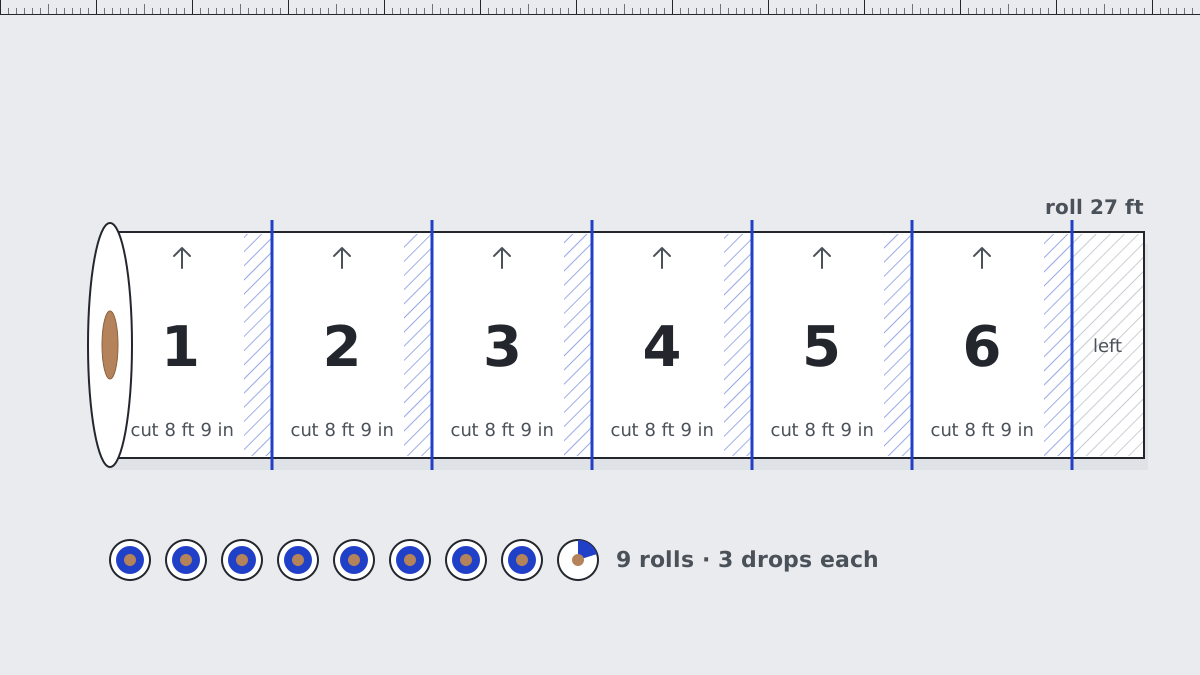
Wallpaper is bought by the roll and used by the drop. A drop is one vertical strip cut from the roll, wall height plus a little spare, hung from ceiling to skirting. A roll gives you a whole number of drops and nothing else: whatever is left after the last full drop is offcut. Every reliable estimate follows from that one fact, and most unreliable ones ignore it.
This guide works the method through a real room. If you would rather have the arithmetic done for you, the calculator does exactly these steps and draws the cuts on the roll as it goes.
What you are calculating
Not area. A roll of 27 in × 27 ft contains about 61 square feet of paper, but you cannot hang 61 square feet of it. You can hang the drops it yields, and how many that is depends on the height of your wall and the repeat of your pattern. On an 8 ft wall with no pattern, that roll yields three drops. On the same wall with a 21 in straight-match repeat, it still yields three. With a half-drop match on the same repeat, it yields two. The area did not change. The answer did.
So the question is: how many drops do my walls need, and how many drops does one roll give me?
Step 1: Measure each wall
Width along the floor, height floor to ceiling. Keep the walls separate. Do not add the widths into one perimeter. Rounding up happens per wall, and a 10 ft wall and a 12 ft wall need 5 + 6 = 11 drops of a 27 in roll, not the 10 you would get from dividing 22 ft by 27 in.
Measure height at the tallest point if the ceiling is uneven. Ignore skirting and coving. The trim allowance covers them.
Step 2: Read the label
Three numbers: roll width, roll length, and the vertical pattern repeat. US labels give width in inches and length in feet; European labels give centimetres and metres (the metric calculator takes those directly). The repeat is printed as a length, often with the match type beside it as a small symbol: an arrow pair for straight, an offset pair for half-drop, a circle or the word “random” for free match.
Note whether the label describes a single or a double roll. In the US it is almost always a double, and the price you were quoted was for a single. More on that in step 6.
Step 3: Count the drops
For each wall: divide its width by the roll width and round up.
| Wall | Width | ÷ 27 in | Drops |
|---|---|---|---|
| A | 10 ft (120 in) | 4.44 | 5 |
| B | 12 ft (144 in) | 5.33 | 6 |
| C | 10 ft (120 in) | 4.44 | 5 |
| D | 12 ft (144 in) | 5.33 | 6 |
| 22 |
The fifth drop on wall A is only 12 in wide. You still cut a full-width drop for it. The offcut is waste, and it is one of the reasons the waste allowance exists.
Step 4: Work out the cut length
Start with the wall height and add trim, about 4 in in total so you have 2 in to trim at the ceiling and 2 in at the skirting. Then apply the match:
- Random (no match): cut length is height + trim. On an 8 ft wall, 96 + 4 = 100 in.
- Straight match: every drop must start at the same point in the pattern, so round the cut up to a whole number of repeats. With a 21 in repeat, 100 in rounds up to 5 × 21 = 105 in.
- Half-drop match: alternate drops shift by half a repeat, so allow the whole-repeat rounding plus half a repeat more: 105 + 10.5 = 115.5 in.
The pattern repeat guide goes into why each match behaves this way.
Step 5: Drops per roll, then rolls
Divide the roll length by the cut length and round down. A 27 ft roll is 324 in.
- Random: 324 ÷ 100 = 3.24 → 3 drops per roll, 24 in left on each.
- Straight, 21 in repeat: 324 ÷ 105 = 3.09 → 3 drops per roll, 9 in left.
- Half-drop, 21 in repeat: 324 ÷ 115.5 = 2.8 → 2 drops per roll, 93 in left. That leftover is a whole 7 ft of paper you cannot use for a full drop.
Now add waste to the drop count and divide. With 22 drops and 10% waste: 22 × 1.10 = 24.2, call it 25 drops. Then:
- Random: 25 ÷ 3 = 8.33 → 9 rolls.
- Straight: 25 ÷ 3 = 8.33 → 9 rolls.
- Half-drop: 25 ÷ 2 = 12.5 → 13 rolls.
Round up every time. Nine and a bit rolls means ten rolls in the shop. The shop does not sell a bit.
Step 6: Translate to what the shop sells
If the label you read was a double roll, the count above is already in double rolls; order nine. If the label described a single roll, shops package two together, so divide by two and round up: nine singles becomes five double rolls. The single vs double roll guide explains why US pricing works like this, and the calculator’s ticket has a switch that does the translation.
Order everything at once and check that every roll carries the same dye-lot number. A shortfall bought later from a different lot may not match.
The area shortcut, and why it under-orders
The method most retailers use is simpler: total wall area, divided by a fixed coverage per roll, often 56 square feet. For the room above that is 352 sq ft × 1.10 ÷ 56 = 6.9 → 7 rolls.
Seven is two short of the strip method’s nine, and the difference is entirely the pattern. The area method does not know that a 21 in repeat turns a 100 in cut into a 105 in cut and leaves 9 in unusable at the end of every roll. On a large repeat or a half-drop the gap widens. The area figure is a useful sanity check, which is why the calculator prints it beside the strip count, but it is not the number to order from.
A quick reference for roll sizes
| Roll | Dimensions | Drops on an 8 ft wall, no repeat |
|---|---|---|
| US single | 20.5 in × 16.5 ft | 1 |
| US double | 20.5 in × 33 ft | 3 |
| US double (wide) | 27 in × 27 ft | 3 |
| European | 53 cm × 10 m (20.9 in × 32.8 ft) | 3 |
The single roll’s one drop is the point: a 16.5 ft roll gives one 8 ft drop and 8.5 ft of offcut. Nobody hangs a room from single rolls, which is why the trade packages them in pairs.
Do the arithmetic for your room
Enter your walls and your label on the wallpaper calculator and watch the drops laid out on the roll. For one feature wall, the accent wall calculator skips the wall list. For a label in centimetres and metres, use the metric calculator. For removable paper with its own roll sizes, there is the peel and stick calculator. For a ballpark by room size before you have measured, the room-size chart lists common rooms under stated assumptions.
Questions people ask
How do I measure how much wallpaper I need?
Measure each wall's width along the floor and its height from floor to ceiling, in feet and inches. Write them down wall by wall rather than adding them into one perimeter, because the drop count is worked out per wall and rounded up per wall. Then read the roll width, roll length, and vertical repeat off the label of the paper you intend to buy.
How do I calculate how many rolls of wallpaper I will need?
Divide each wall's width by the roll width and round up to get drops. Work out the cut length: wall height plus about 4 in of trim, rounded up to a whole pattern repeat. Divide the roll length by the cut length and round down for drops per roll. Add 10% to the drop count for waste, divide by drops per roll, and round up. That is the roll count.
What is the wallpaper calculation formula?
Rolls = ceil( drops × (1 + waste) ÷ drops per roll ), where drops = Σ ceil(wall width ÷ roll width) and drops per roll = floor( roll length ÷ cut length ). Cut length is wall height plus trim rounded up to the repeat, plus half a repeat for a half-drop match.
How do I calculate how much wallpaper I need with a pattern?
The pattern changes only the cut length. Round the cut up to a whole number of repeats for a straight match; add a further half repeat for a half-drop. Fewer drops then fit on each roll, and the roll count rises. The pattern repeat guide covers each match type.
How do I account for doors when calculating wallpaper?
Usually by leaving them in. A drop beside a door still runs the full height above it and still has to match its neighbour, so the paper saved is less than the door's area. Deduct only on plain paper with large openings, and then in whole drops. The doors and windows guide sets out both cases.
What is a double roll of wallpaper?
In the United States, a roll twice the length of the single roll the price is quoted for. Most US wallpaper is priced by the single and packaged as a double, so a label saying 27 in × 27 ft is describing a double roll worth two singles of paper. The single vs double guide explains the habit.
How do I calculate wallpaper waste?
As a percentage added to the drop count before dividing by drops per roll. Ten percent is the trade habit for plain paper. 15–20% suits a large repeat, a half-drop match, a room with many corners, or a first job. The waste guide has a scenario table.
How do I calculate wallpaper for an accent wall?
The same way, for one wall. Drops = wall width ÷ roll width rounded up; cut length as above; drops per roll; then rolls. The accent wall calculator is set up for a single wall so you are not managing a list.