PatternBy wallpaper-calculator
Wallpaper Pattern Repeat Explained (Straight vs Half-Drop)
What the vertical repeat on a wallpaper label means, how random, straight, and half-drop matches differ, and exactly how each one changes the length of every cut and the number of rolls you order.
Use the calculator: Wallpaper Calculator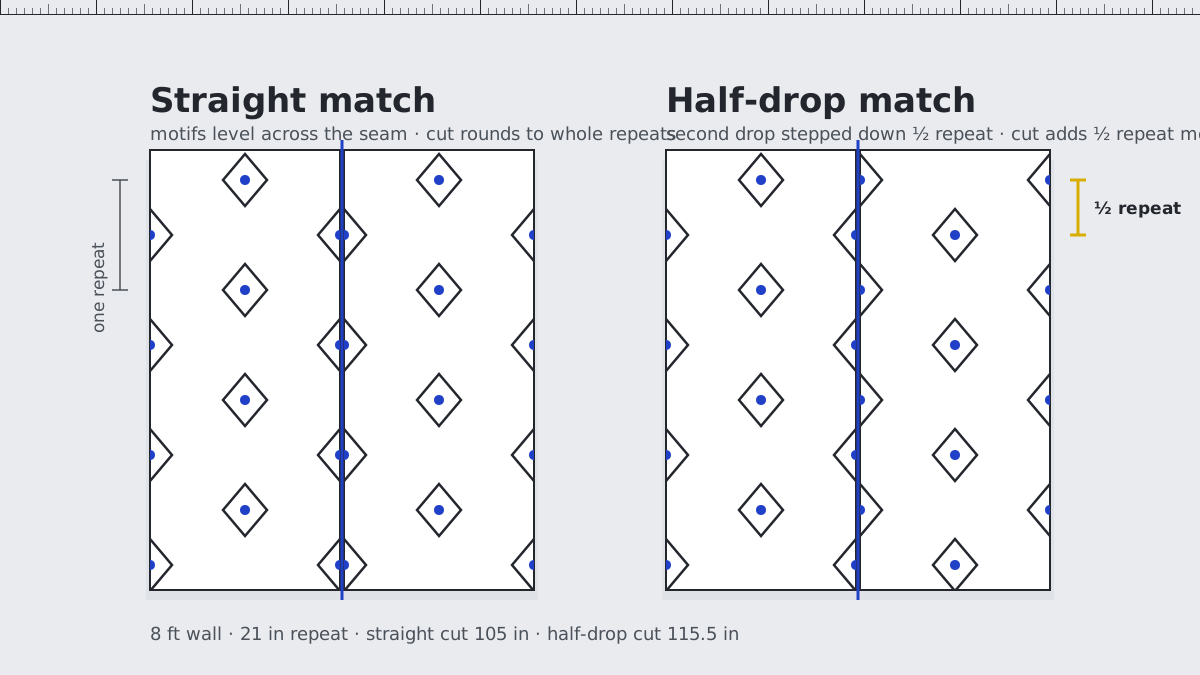
The repeat is the number on a wallpaper label that people skip, and it is the one that most often turns a seven-roll estimate into a nine-roll order. It does not change how many drops your walls need. It changes how long each drop has to be cut, which changes how many drops you get from a roll, which changes everything downstream. The calculator applies it for you if you enter the match type and the repeat. This guide is about understanding what you entered.
What the vertical repeat is
Look at any point in the design. Move straight down the roll until the same point appears again. That distance is the vertical repeat. Small geometric prints repeat every few inches. Large florals and scenic papers can repeat every 24 or 36 in. A plain texture or a vertical stripe has no repeat that matters, because any two pieces line up however you cut them.
The repeat is printed on the label as a length. US labels give inches. European labels give centimetres. The metric calculator takes the centimetre figure as it is printed.
The three match types
Alongside the repeat, the label tells you how neighbouring drops relate to each other. There are more variants in the trade, but three cover almost everything sold to homeowners.
Random match (also free match). No alignment between drops, which is how textures, grasscloth and most stripes behave. Each drop is cut to the wall height plus trim, nothing more.
Straight match (also straight across). The motif sits at the same height on every drop, so the pattern runs level across each seam. To make that work, every drop has to start at the same point in the pattern, which means every cut is rounded up to a whole number of repeats.
Half-drop match (also drop match or offset match). Each drop is shifted down by half a repeat relative to its neighbour, so the motifs step diagonally across the wall. Large-scale designs are often half-drop because it hides the horizontal banding a straight match can produce. It costs the most paper, because on top of rounding to whole repeats you have to allow for the half-repeat shift on alternate drops.
How the match changes the cut
Take an 8 ft wall (96 in) and 4 in of trim, so 100 in of paper before the pattern is considered. Now apply a 21 in repeat.
| Match | Rule | Cut length | Drops from a 27 ft roll |
|---|---|---|---|
| Random | height + trim | 100 in | 3 (24 in left) |
| Straight | round up to whole repeats | 105 in | 3 (9 in left) |
| Half-drop | whole repeats + ½ repeat | 115.5 in | 2 (93 in left) |
The half-drop row is the one to look at. The same roll on the same wall gives two drops instead of three, and the leftover on every roll is 93 in, nearly 8 ft of paper that cannot make a full drop. On a room needing 22 drops that is 11 rolls before waste instead of 8.
Why calculators disagree about patterned paper
Retailer calculators that divide wall area by a fixed coverage per roll cannot see the repeat, because area does not know about cuts. Some add a percentage for pattern instead, which is a guess about the rounding rather than the rounding itself. The strip method used on this site does the rounding, and then prints the area figure beside it so you can see how far apart they are on your room. On a small repeat they agree. On a large half-drop they can differ by a third.
Reading the repeat off the label
The repeat appears as a length: “Repeat 21 in”, “Vertical repeat 53.3 cm”, “Pattern repeat 64 cm”. The match type appears next to it either as a word or as a symbol. Two arrows level with each other mean straight match. Two arrows with one offset mean half-drop. A circle, a dash, or the word “random” means free match.
If you only have a sample, find a distinctive point in the motif and measure straight down to where the same point next appears. Hold two pieces side by side to see whether they line up level (straight) or need shifting (half-drop).
Murals are a different question
A mural is one picture printed across a numbered set of panels. There is no repeat, and the question is not how many drops fit on a roll but how many panels the wall needs and how much trims off. The mural and panel calculator handles that.
Enter it and watch the cut change
On the wallpaper calculator, choose the match type and type the repeat from your label. The hatched end of every drop on the roll drawing is the rounding you have just read about, and the readout shows drops per roll falling as the repeat rises. The waste guide covers the allowance that sits on top of it, and the room-size chart shows how the same room comes out under a plain match and a large one.
Questions people ask
What is wallpaper pattern repeat?
The vertical distance, measured down the roll, before the design starts again. A 21 in repeat means the motif at any point reappears 21 in below it. The label prints it as a length, usually beside a small symbol for the match type.
How many rolls of wallpaper do I need with a pattern repeat?
Work out the cut length first: wall height plus about 4 in of trim, rounded up to a whole number of repeats (and half a repeat more for a half-drop). Divide the roll length by that cut and round down for drops per roll. Then divide your total drops, with waste added, by drops per roll and round up. The repeat never changes how many drops a wall needs. It changes how many drops a roll gives you.
How do I calculate wallpaper with a pattern repeat?
On an 8 ft wall with a 21 in straight repeat: 96 in + 4 in trim = 100 in, rounded up to 5 × 21 = 105 in per drop. A 27 ft (324 in) roll yields floor(324 ÷ 105) = 3 drops. With no repeat the cut is 100 in and the roll still yields 3, but with a 24 in repeat the cut becomes 120 in and the roll yields only 2. The calculator takes the repeat and match type directly.
How do I find the pattern repeat on wallpaper?
It is printed on the label and on the product page, as a length: "Repeat 21 in", "Vertical repeat 53.3 cm", or similar. Some makers print a match symbol beside it. If you only have a sample, measure from a point in the motif straight down to the same point where it next appears.
What is the difference between a straight match and a half-drop match?
With a straight match, the motif sits at the same height on every drop, so the pattern runs level across the seams. With a half-drop (also called drop match or offset match), each drop is shifted down by half a repeat relative to its neighbour, so the pattern steps diagonally. Half-drop needs more paper per drop because you have to allow for that shift.
How does the pattern repeat affect wallpaper quantity?
Through the cut length. Every drop is cut to a whole number of repeats so the pattern lines up, which makes each cut longer than the wall. Longer cuts mean fewer drops per roll, and fewer drops per roll means more rolls. The bigger the repeat, the bigger the rounding and the more you order.
How do I tell whether a paper is random, straight, or half-drop match?
Read the label. Random (free) match is often shown as a circle or the word random and is common on textures and stripes. Straight match shows two arrows level with each other. Half-drop shows two arrows with one offset. If the label only gives a repeat with no symbol, treat it as straight and check the sample by holding two pieces side by side.
Does a wallpaper calculator work for murals?
Not a roll calculator. Murals are printed as a set of panels that make one picture, with no repeat, and the question is how many panels cover the wall rather than how many drops fit a roll. Use the mural and panel calculator for those.