BuyingBy wallpaper-calculator
Single vs Double Rolls of Wallpaper (US Buying Guide)
Why American wallpaper is priced by the single roll and sold by the double, what each one actually holds, and how to avoid ordering half or twice what your walls need.
Use the calculator: Wallpaper Calculator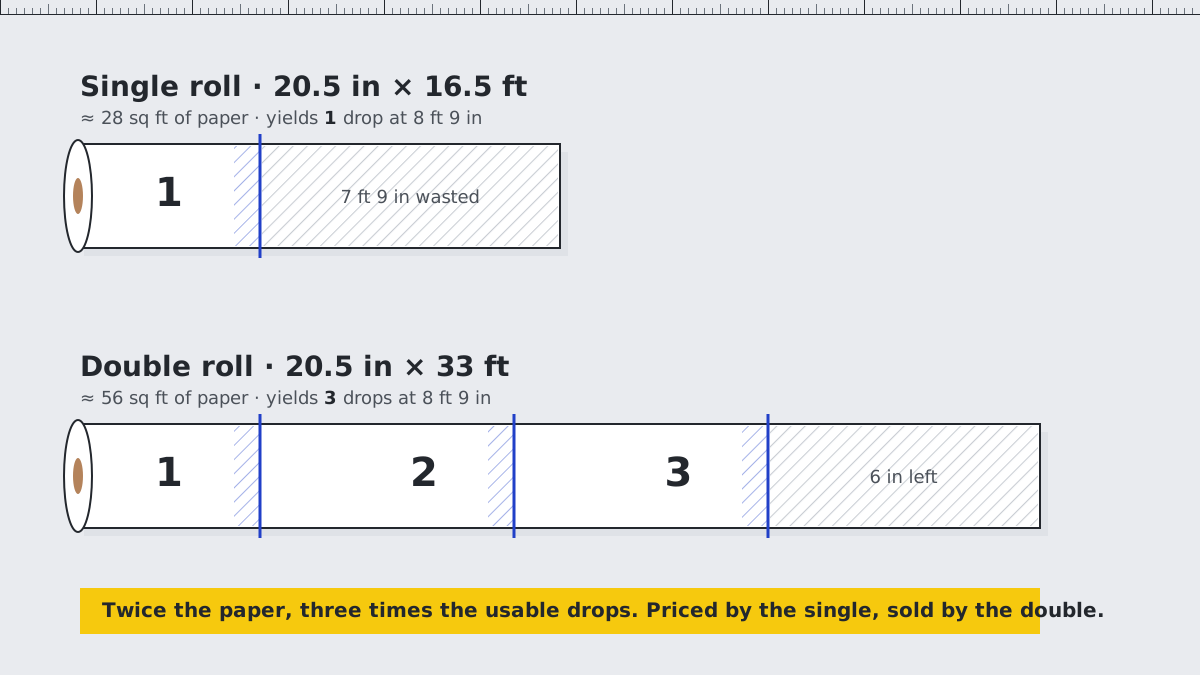
American wallpaper is priced by the single roll and sold by the double. That one sentence explains a large share of wallpaper ordering mistakes, and almost no retailer states it plainly on the product page.
The calculator has a switch for which one your label describes, so the count it gives you matches what the shop will hand over. This page explains what the switch is for.
Single vs double roll wallpaper, in one table
A single roll is the historical unit of American wallpaper: roughly 13 to 16.5 ft long, at a width of 20.5, 27, or 28 in. It holds about 28 sq ft of paper.
A double roll is two singles’ worth on one continuous bolt: 27 to 33 ft long at the same width, holding 56 to 61 sq ft.
Both descriptions refer to the same product line. A maker whose single roll is 20.5 in × 16.5 ft sells it as a 20.5 in × 33 ft double, and the price on the shelf is for the single.
| Length | Width | Paper | Drops on an 8 ft wall | |
|---|---|---|---|---|
| US single roll | 16.5 ft | 20.5 in | ≈ 28 sq ft | 1 |
| US double roll | 33 ft | 20.5 in | ≈ 56 sq ft | 3 |
| US double roll (wide) | 27 ft | 27 in | ≈ 61 sq ft | 3 |
| European roll | 10 m (32.8 ft) | 53 cm (20.9 in) | ≈ 57 sq ft | 3 |
The last column is the reason doubles exist. A 16.5 ft single yields one 8 ft 9 in drop and wastes 7 ft 9 in. Bolt two together and you get three drops with 6 in left. The same paper, packaged differently, yields 50% more usable wall.
Why the pricing persists
The convention comes from a time when wallpaper genuinely shipped in single rolls and prices were compared per single. Machinery changed, the packaging moved to doubles, and the pricing did not follow. Some brands are explicit about it. Thibaut’s estimating notes state that paper is priced by the single roll and usually packaged as a double. Others leave you to infer it from a length that does not match the roll you thought you were buying.
The two mistakes
Ordering half. You work out that you need nine rolls’ worth of paper, see a price per single roll, and buy nine. Nine doubles arrive, which is eighteen singles’ worth, and you have twice what you need. Wallpaper is frequently non-returnable once the shrink wrap is off.
Ordering double. The opposite: your estimate was in singles, you buy that many doubles. Less common, and more expensive.
Both come from the same root, which is that “roll” in an estimate and “roll” in a listing are not always the same unit. Put the label’s actual width and length into a calculator and the ambiguity disappears, because you are describing a physical object rather than a unit of account.
What to do
- Read the dimensions, not the word “roll.” Width and length are unambiguous. The word is not.
- Tell the calculator which you entered. The ticket on the calculator has a single/double switch, and the flag beneath the result translates for you.
- Check the price basis before checkout. If the price is per single and the package is a double, the line total is twice the unit price.
- Order the whole job at once, from one dye lot. This matters more than the packaging question: a replacement roll bought later can be a visibly different shade.
Europe does it differently
A European roll is a single roll sold as a single roll, typically 53 cm × 10 m, and the price is for what arrives. There is no doubling convention to unpick. The lengths are similar to a US double, which makes the two look interchangeable when they are not: 10 m is 32.8 ft, close to a 33 ft US double, but a 53 cm width is narrower than 27 in.
If your measurements and your label are both metric, the metric calculator works in centimetres and metres throughout. The metres vs feet guide sets the two systems side by side.
For specialty wallcoverings sold from the bolt by the linear yard, neither convention applies, and the by-the-yard calculator is the right sheet.
Questions people ask
What is a double roll of wallpaper?
Two single rolls' worth of paper packaged as one continuous roll. In the United States wallpaper is traditionally priced per single roll but bolted and sold in doubles, so a package described as 27 in × 27 ft is a double roll holding what two 13.5 ft singles would.
Why is wallpaper sold in double rolls?
Because a single roll is too short to be useful. At 13 to 16 ft, a single yields one drop on an 8 ft wall and wastes the rest. Bolting two together gives three usable drops instead of two separate ones with a long offcut on each, so the trade packages doubles and keeps the old single-roll pricing.
How much does a double roll of wallpaper cover?
Multiply the width by the length: about 56 sq ft for a 20.5 in × 33 ft double, and about 61 sq ft for a 27 in × 27 ft double. Usable coverage is lower, because each drop is cut to length and the remainder of the roll is offcut.
How much does a roll of wallpaper cover?
It depends entirely on which roll is meant. A US single covers around 28 sq ft, a US double around 56 to 61 sq ft, and a European 53 cm × 10 m roll around 57 sq ft. Asking how much a roll covers without saying which roll is the source of most ordering mistakes.
How much does 2 rolls of wallpaper cover?
Two US doubles cover roughly 112 to 122 sq ft of paper, enough for about six drops on an 8 ft wall. Two singles cover about 56 sq ft and yield two drops. The same phrase describes two very different quantities.
How many pieces of wallpaper are in a roll?
A roll is one continuous length, not pieces. What varies is how many drops you can cut from it: three from a 27 ft double at an 8 ft wall height, one from a 16.5 ft single. That number, not the roll count, is what decides your order.
Does wallpaper come in single rolls?
Rarely as a physical product in the United States, though the price is still quoted that way. Some specialty and imported papers are sold as true singles, and European rolls are single rolls by definition. If a listing gives a price per single roll and a length that looks like a double, the price is per half of what arrives.
What does wallpaper priced by the single roll mean?
That the advertised price buys half of what is delivered. A paper at $45 per single roll, packaged in doubles, costs $90 per package. This is not a trick, it is an old convention that persists, but it does make comparison with European rolls and with peel-and-stick misleading unless you convert first.